

Roughly half of all Americans are turning to artificial intelligence to make important decisions about their health, often without the guidance of a medical professional, a new national survey has found. The poll from the Ohio State University Wexner Medical Center highlights a growing reliance on AI for self-diagnosis, prompting concern from doctors who stress that technology cannot substitute for human medical expertise.
The survey reveals a significant number of patients are using AI chatbots and other tools to interpret symptoms, research conditions, and make choices about their medical care. However, this embrace of technology is coupled with a sense of unease. The same poll found that the number of Americans who feel comfortable with the use of AI in their own healthcare has actually decreased compared to a similar study conducted in 2024.
This paradox suggests that while many are drawn to the convenience and immediate answers provided by AI, there remains an underlying apprehension about its reliability and role in a field as critical as personal health. The trend points to a broader societal shift in how people access information, with many now defaulting to digital tools for answers to their most personal questions.
The doctor's perspective
Medical professionals are urging caution, emphasizing the inherent limitations of artificial intelligence in a clinical context. While AI can process vast amounts of data, it lacks the nuanced understanding and personal history a human doctor brings to a diagnosis. AI algorithms cannot conduct a physical examination, observe non-verbal cues, or understand the complex interplay of a patient's lifestyle, family history, and unique circumstances.
Experts warn that relying on AI for a diagnosis can be misleading or even dangerous. An incorrect interpretation of symptoms could lead to unnecessary anxiety if a benign condition is mistaken for a serious one. Conversely, a false sense of security from an AI "all-clear" could cause someone to delay seeking treatment for a genuine and urgent medical issue, potentially leading to worse outcomes. The core of the concern is that medicine is both a science and an art, requiring a level of interpretive skill that current AI cannot replicate.
A tool, not a replacement
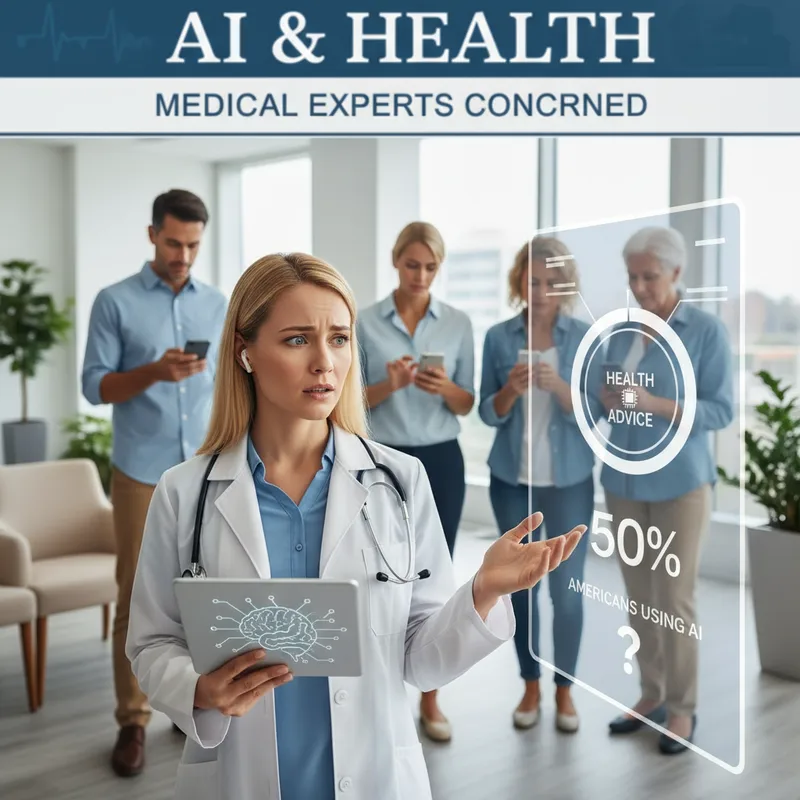
Despite the risks, experts are not calling for a complete ban on using AI for health information. Instead, they recommend a shift in how patients approach these tools. The consensus is that AI should be used to prepare for a medical appointment, not to bypass it. Patients can use AI to research their symptoms, learn medical terminology, or formulate a list of specific questions to ask their doctor. This can lead to a more productive and collaborative consultation.
The key, according to the professionals surveyed, is transparency. Patients who use AI to gather information should share what they have found with their doctor. This allows the physician to address any misinformation, confirm accurate details, and integrate the patient's own research into a comprehensive and professional evaluation. This approach reframes AI from a would-be diagnostician into a patient-empowerment tool.
Public uncertainty about the future role of AI is not unique to healthcare. A separate recent report from the sales software company Pipedrive found that public opinion is sharply divided on how automation will impact professions like sales. While some believe AI will make certain jobs obsolete, others expect it to handle mundane tasks, allowing humans to focus on more strategic and skilled work. This mirrors the debate in healthcare, where the ideal role for AI is seen as a supportive one that enhances, rather than replaces, the doctor-patient relationship.
A broader knowledge gap
This growing dependence on technology for fundamental needs like healthcare may reflect broader trends in public knowledge and literacy. A 2022 survey from the Annenberg Public Policy Center at the University of Pennsylvania, for example, found a troubling decline in Americans' basic civics knowledge. The study revealed that less than half of U.S. adults could name the three branches of government, a drop after several years of improvement.
Kathleen Hall Jamieson, director of the center, noted at the time how critical this knowledge is, stating, "We are unlikely to cherish, protect, and exercise rights if we don’t know that we have them." The same principle can be applied to health literacy, as individuals seek more information about disaster recovery, such as in FEMA offers disaster aid for December storm recovery. An over-reliance on unverified or context-free information from an AI, without the foundational understanding of one\'s own health or the healthcare system, can be disempowering and risky.
In both civics and health, "knowledge is power." Just as a lack of civic awareness can make one vulnerable to misinformation and compromise democratic participation, a lack of health literacy can lead to poor decisions that jeopardize personal well-being. The challenge, therefore, lies not just in developing better AI, but in improving public education and critical thinking skills so people can use these powerful new tools responsibly.
Ultimately, while AI can be a powerful resource for information, medical professionals maintain that it cannot replicate the trust, empathy, and holistic understanding that form the bedrock of the doctor-patient relationship. Patients are advised to view AI as a supplementary tool and to always rely on a qualified healthcare provider for final diagnoses and treatment plans.