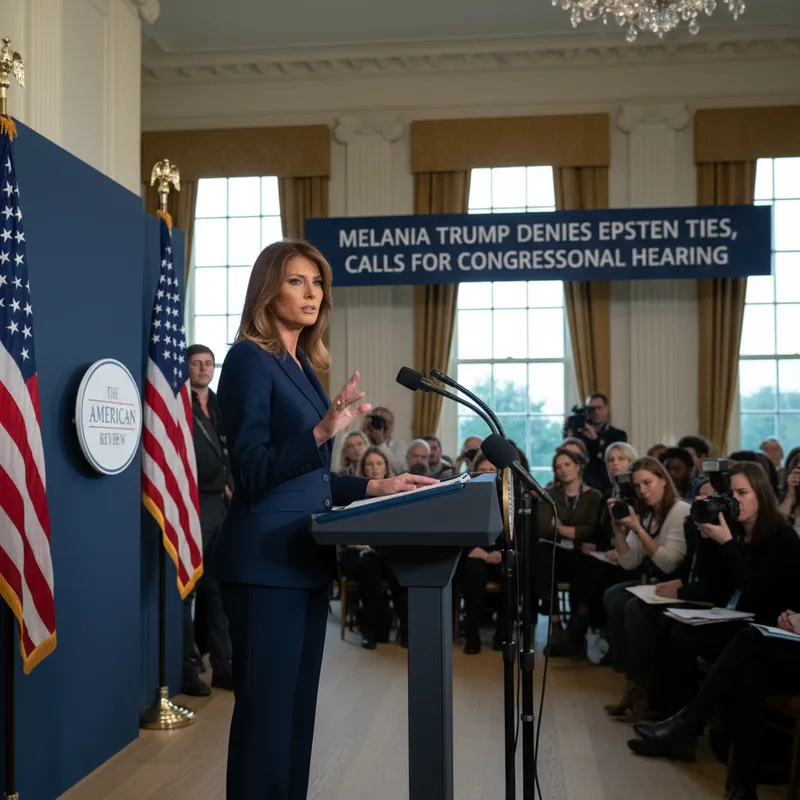
First Lady Melania Trump made a rare and unexpected public statement from the White House, unequivocally denying any personal relationship with the disgraced sex offender Jeffrey Epstein. In her address, she also issued a direct call to Congress, urging lawmakers to convene a formal hearing for the survivors of Epstein's abuse.
"I have never had a relationship with him," Mrs. Trump stated, seeking to distance herself from the ongoing narrative surrounding Epstein and his connections to powerful figures. Her intervention brings new life to a story the White House has reportedly been eager to move past, placing the first lady at the center of a national conversation about justice and victim advocacy.
The statement was notable for its rarity, as Mrs. Trump has maintained a relatively private posture compared to many of her predecessors. By choosing to address the issue directly, she has thrust herself and the White House back into the complex and politically charged aftermath of the Epstein scandal. The call for congressional action, in particular, shifts the focus toward the legislative branch's responsibility to the survivors.
A first lady's call to action
Melania Trump's demand for a congressional hearing for Epstein's survivors represents a significant move, leveraging her platform to advocate for those affected by his crimes. This call to action places public pressure on lawmakers to address the issue head-on, potentially through testimony and investigation. The move was widely seen as an attempt to reframe the narrative around the Epstein issue, focusing on the victims rather than on alleged associations.
Historically, first ladies have often championed specific social or health initiatives, but a direct call for a congressional hearing on a matter of this nature is less common. The success of this plea will depend on the willingness of congressional leaders to take up the cause. With Congress returning to a busy schedule, including key judicial nominations, the path to such a hearing remains uncertain but has now gained a high-profile advocate.
The backdrop to Mrs. Trump’s statement is a White House navigating numerous domestic and international challenges. The administration has been simultaneously managing sensitive foreign policy, including a fragile ceasefire in the war with Iran, and domestic controversies ranging from legal battles over White House renovations to the president's own provocative social media posts on immigration.
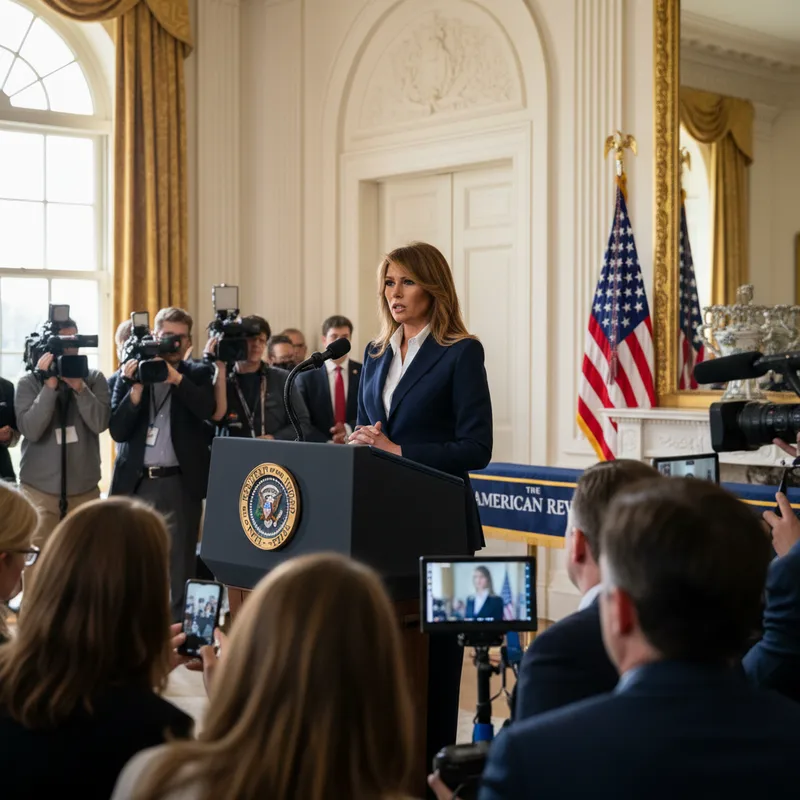
This context makes the first lady's decision to speak out on the Epstein case all the more striking. It highlights a deliberate effort to engage on a specific issue of public concern, separate from the broader political churn consuming the administration.
A White House on multiple fronts
The first lady's statement comes as the Trump administration contends with a complex war with Iran. After five weeks of conflict that saw Iran solidify control over the Strait of Hormuz, President Trump announced a two-week ceasefire. The president has expressed optimism about a potential peace deal, even as the temporary truce appears strained by continued Israeli military action in Lebanon.
Leading the peace talks is Senator JD Vance of Ohio, a freshman senator and veteran of the post-9/11 wars who was initially skeptical of a conflict with Iran. His emergence as a key negotiator underscores the administration's focus on finding a diplomatic exit from a war that has yielded mixed results for U.S. strategic goals. Domestically, efforts to constrain the president's war powers have been a point of contention in Congress, with House Republicans recently blocking a Democratic-led effort to force a vote on a war powers resolution.
Simultaneously, the administration is engaged in legal battles closer to home. A federal appeals court recently ruled that construction could temporarily proceed on a new White House ballroom, a project the administration has defended as a "vital project" necessary for the first family's safety. The White House has signaled it is prepared to take the case to the Supreme Court if necessary.
President Trump has also continued to use his platform to weigh in on contentious social issues. He recently posted a graphic video of a deadly hammer attack, blaming Democratic immigration policies for the violence. As previously reported, a former sheriff's lieutenant was charged with murder in a deadly fireworks blast. The Department of Homeland Security has stated the suspect, a Haitian national, will be deported regardless of the case's outcome.
Uncertain path forward for survivors' hearing
While Melania Trump has used her powerful voice to call for a congressional hearing, the political divisions in Washington may prove to be a significant obstacle. The recent partisan clashes over the Iran war demonstrate a Congress deeply split on major issues, which could complicate efforts to organize a bipartisan hearing for Epstein's survivors.
For now, the first lady's call has placed the responsibility squarely on the shoulders of Congress. Her statement ensures that the conversation about Jeffrey Epstein does not fade from public view and, more importantly, centers the voices and experiences of his victims. Whether lawmakers will heed her call remains a critical, unanswered question.