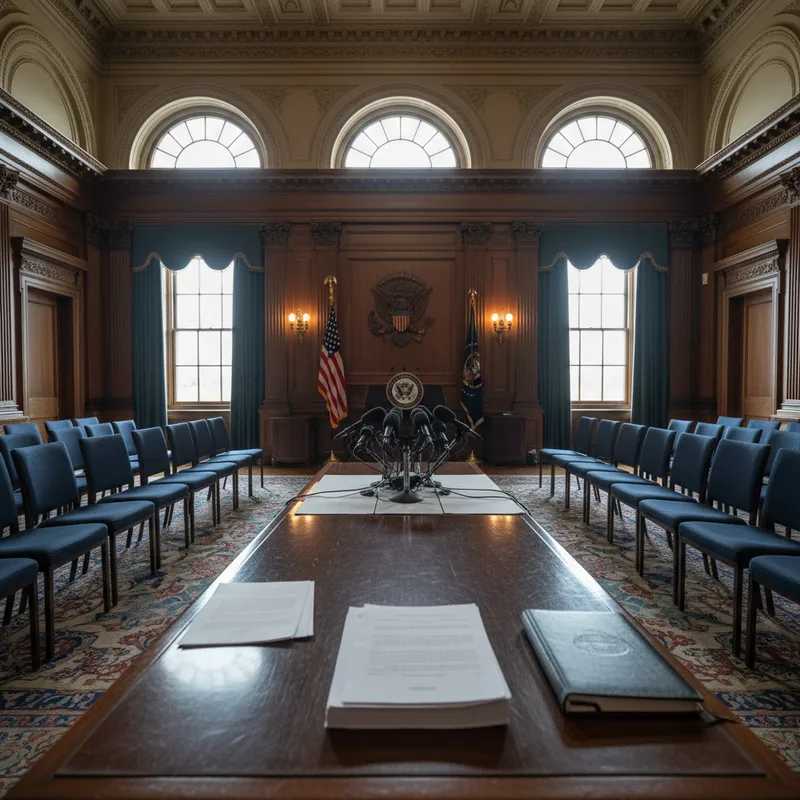
A Southern California man has been charged with attempting to assassinate President Donald Trump after gunshots disrupted the annual White House Correspondents' Association dinner in Washington, D.C. The suspect, identified as 31-year-old Cole Tomas Allen, faces a potential life sentence if convicted on the charge, in addition to other firearms offenses.
Allen made his initial court appearance following the incident at the Washington Hilton hotel, where the nation's political leaders, journalists, and diplomats had gathered. The shooting shattered the evening's customary atmosphere of collegiate roasting and celebration, sparking a major security response and raising new questions about the president's safety.
Secret Service agents and the suspect reportedly exchanged fire on a level of the hotel one floor above the ballroom where President Trump, the first lady, and hundreds of guests were located. After the shots rang out, agents swiftly evacuated the president from the venue. The incident marks the third major security threat against Trump in recent years, prompting a new wave of scrutiny over the protocols in place to protect the commander-in-chief.
Security under scrutiny
With the investigation in its early stages, officials are examining how a gunman was able to get into a position to open fire at such a high-profile event. While street closures were in effect for hours around the hotel, some who attended the dinner described security at the venue itself as surprisingly lax. One guest noted that his ticket was only given a cursory look from a distance by a person at the door.
The incident is forcing a national conversation about the immense challenges involved in protecting a president, particularly one as polarizing as Donald Trump. In a moment of reflection just hours after the chaos, the president highlighted the constant threat he faces.
The attempt has also reignited the spread of conspiracy theories online, which circulated so rapidly that they reportedly alarmed President Trump himself. The White House has publicly dismissed the unfounded claims as 'crazy nonsense' and condemned all forms of political violence.
A history of presidential threats
This latest security breach adds another chapter to the long and troubling history of assassination plots against U.S. presidents. The nation has seen four of its leaders assassinated in office: Abraham Lincoln in 1865, James A. Garfield in 1881, William McKinley in 1901, and John F. Kennedy in 1963. Numerous other attempts on sitting and former presidents have been thwarted over the past two centuries, underscoring the perpetual danger that accompanies the office.
For President Trump, this marks the third publicly known attempt on his life since 2024. The first occurred in the summer of that year at a rally in Butler, Pennsylvania, where a bullet grazed his ear. Just 64 days later, he was targeted again while playing golf at his course in Florida. These repeated incidents have put the Secret Service, the federal agency tasked with protecting the president, under immense pressure to adapt to an evolving threat landscape. The challenge is compounded by modern technology and the divisive political climate. The use of digital tools for surveillance and investigation is a subject of ongoing legal debate, with the Supreme Court recently considering the lawfulness of broad police requests for cellphone location data, a technique often used to identify suspects near a crime scene. Similarly, officers seized $5M in methamphetamine at Otay Mesa port, highlighting the complex challenges that face law enforcement.
A capital on edge
The shooting occurred during a particularly busy week in the nation's capital. On the same day, King Charles and Queen Camilla of the United Kingdom arrived for a state visit to meet with the president, a diplomatic effort aimed at smoothing a recently strained relationship between the two allies. The juxtaposition of a state visit and an assassination attempt highlights the complex and often unpredictable nature of presidential responsibilities.
While security concerns dominated headlines, other political developments continued to unfold. Florida Gov. Ron DeSantis released a new congressional map intended to create four more Republican-leaning seats, a move that has drawn concern from some within his own party. Meanwhile, the National Trust for Historic Preservation confirmed it would continue its lawsuit against the construction of a new White House ballroom, despite pressure from the Department of Justice.
The charges against Allen, a native of the same region where federal officers recently seized millions in narcotics at the border, now move the focus to the judicial system. As the case proceeds, it will likely fuel further debate on political violence, security protocols, and the deep divisions present in American society.