
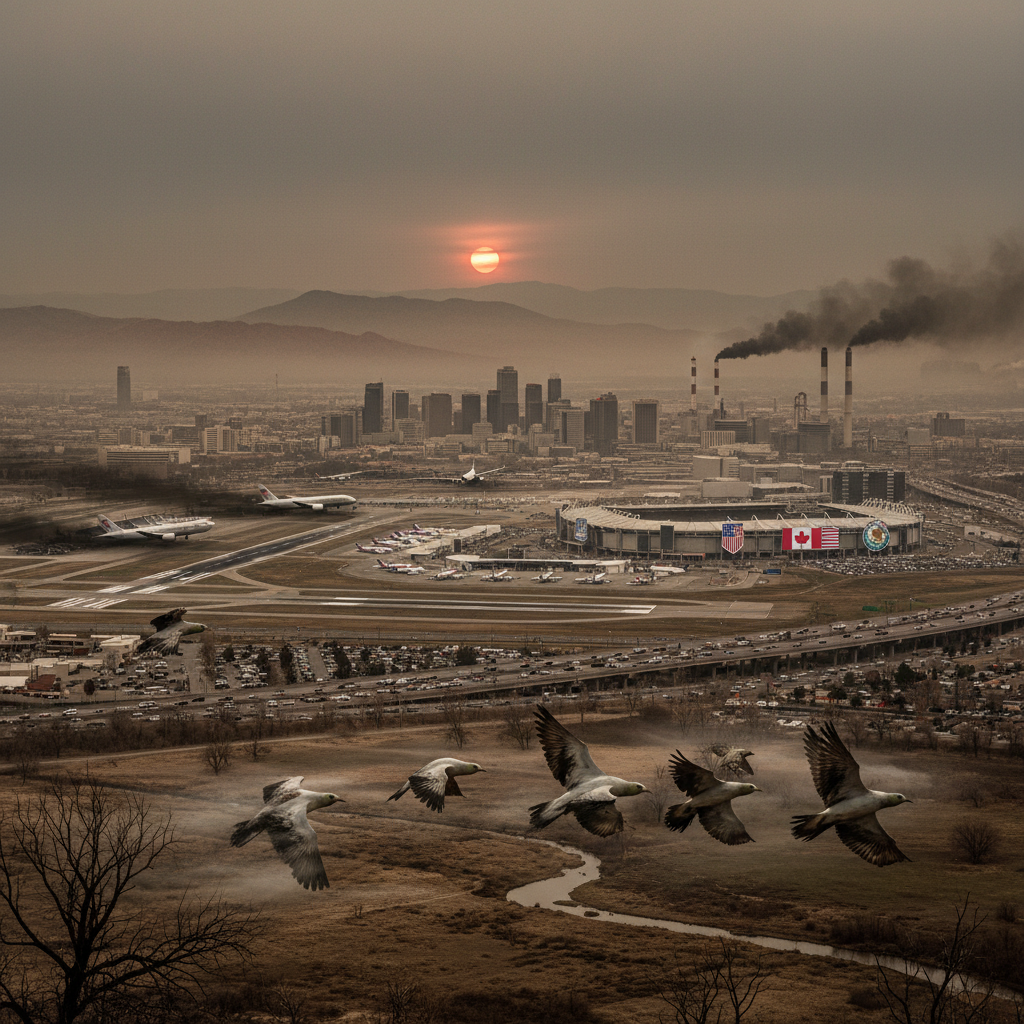
The 2026 FIFA World Cup, currently unfolding across North America, is poised to be celebrated for its unprecedented scale, spanning three countries and 16 host cities. Yet, as millions of fans tune in, researchers are highlighting a more troubling distinction: the tournament is on track to be the most polluting in history, leaving a massive carbon footprint that dwarfs its predecessors.
A new analysis projects the event will generate more than nine million tons of carbon dioxide, a staggering figure that raises serious questions about the environmental sustainability of international mega-events. The primary culprit is air travel, a necessary consequence of the tournament's continent-spanning format, which encourages fans, teams, and organizers to fly between venues in Canada, Mexico, and the United States.
This year's World Cup is the first to be hosted by three nations, a decision intended to share both the costs and the excitement. However, this decentralized model has created an environmental challenge that overshadows the sporting spectacle. The vast distances between cities like Vancouver, Mexico City, and Miami have made extensive air travel unavoidable for the millions of people participating in the event.
A record-breaking carbon footprint
Research from the University of Sussex in the United Kingdom paints a stark picture of the tournament's environmental impact. "Our research estimates that the total impact of the tournament is going to be around just over 9 million tons of CO2," said Freddie Daley, a researcher at the university and a campaigner with the Cool Down Sport for Climate Action Network.
To put that number in perspective, it is nearly double the average of previous tournaments. "If you take the weighted average from 2010 up to Qatar 2022, the average is about 4.71 million tons of CO2," Daley said. "So you can see it’s significantly larger."
The overwhelming majority of these emissions are directly linked to transportation. "Of that total, just under 8 million tons, so about 7.72 is directly from air transport from fans and teams," Daley noted. This focus on air travel emissions highlights the central tension of modern global events, which aim to bring the world together but do so at a significant environmental cost. The carbon footprint from flights alone is greater than the total footprint of several past World Cups.
Local communities feel the impact

While the carbon emissions are global, the immediate effects are intensely local. In host cities like Los Angeles, communities near airports and stadiums are on the front lines. Los Angeles World Airports officials estimate that Southern California will see about 290,000 visitors for the tournament, with nearly 40% arriving from other countries. This influx places a heavy burden on infrastructure and the environment.
Lia Cohe, the manager for climate planning and resilience with the Los Angeles-based nonprofit Climate Resolve, points to the direct consequences for residents. Communities like Inglewood, home to both Los Angeles International Airport and Los Angeles Stadium, will experience a surge in traffic, noise, and pollution.
From cars, from transportation, from planes, from everything, and all of that in the short-term has like big public health impacts, right? From vehicles idling in these communities, from the air quality impacts, so those are an obvious nexus.
Cohe’s organization works to help underserved communities confront the effects of climate change. For these residents, the World Cup is not just a distant event but a source of immediate concern for their health and well-being. The issues compound as Los Angeles also prepares to host the Super Bowl in 2027 and the Summer Olympics in 2028, sparking a broader conversation about how American cities can manage the impacts of such large-scale events.
FIFA's climate goals face reality check
In response to growing criticism, FIFA, the international governing body for soccer, has stated its own environmental goals. The organization has a public commitment to reduce its carbon emissions by 50% by 2030 and has joined the UNFCCC’s Sports for Climate Action framework. For the 2026 tournament, FIFA said in a statement that it is promoting the use of public transport, walking, and cycling. The organization also said it is working to reduce reliance on diesel generators and increase recycling and food waste reduction at venues.
However, these mitigation efforts appear insufficient to counteract the enormous emissions generated by the tournament’s structure. The 2026 event’s projected footprint suggests that current strategies are not enough to align mega-events with meaningful climate action, presenting a significant challenge to FIFA's 2030 target. Similar conversations are happening in other countries, as Canadian cities launch new tactics to attract major events while balancing economic and environmental concerns.
Despite the negative environmental narrative, advocates see an opportunity to leverage the moment for positive change. "Thinking about the intersection of sports and climate is really big," Cohe said. "I think that these sporting events obviously drive a lot of negative stories, a lot of emissions, a lot of things that we don’t have in our day-to-day but I think sports is one of the biggest unifying forces that we have."
The challenge, according to Cohe, is to channel that unifying power into building a more sustainable future. For her, this includes ensuring that communities are prepared for the long-term impacts of climate change, long after the stadiums have emptied. "We know that there’s going to be these climate impacts coming down the line but that our homes are built for them," she said. "That we have proper insulation and cooling and electricity and heat pumps and things that make it so that we can meet the moment with the infrastructure that we have."
As the World Cup continues, the debate over its environmental legacy serves as a crucial test for the future of global sports. The record-breaking emissions of 2026 may force a reckoning, pushing organizers, cities, and fans to decide whether the price of admission is one the planet can afford to pay.