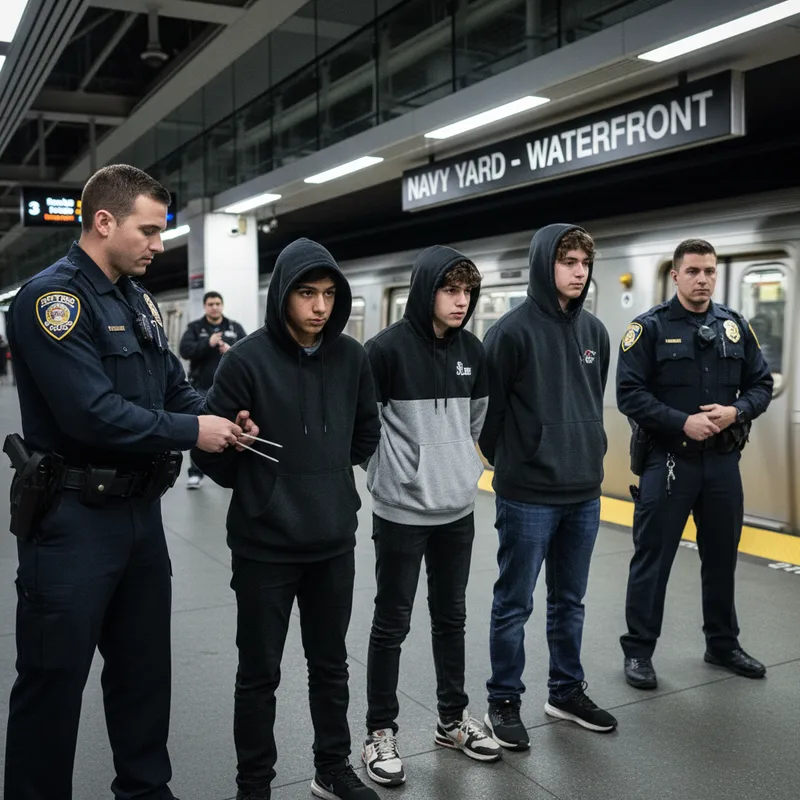
Metro Transit Police arrested four teenagers Saturday night in and around the Navy Yard-Ballpark and Waterfront Metro stations, as large crowds of young people gathered in the area despite a targeted youth curfew.
A spokesperson for the Washington Metropolitan Area Transit Authority (WMATA) confirmed that the arrests took place at the Waterfront Station. Three of the minors were taken into custody for disorderly affray, while a fourth was arrested for disorderly conduct, assaulting a police officer, and unlawful entry. Authorities did not release the ages of the individuals or state whether they had been released to their parents or guardians.
The incidents occurred during what some officials have termed a “teen takeover,” where large groups of young people gather, sometimes leading to disruptive or dangerous behavior. These events have become a recurring challenge for law enforcement in the District.
Ongoing debate over youth curfews
The arrests highlight the ongoing struggle to manage youth gatherings in the city, even with specific measures in place. The Navy Yard area was under a special youth curfew zone for the weekend, running from 8 p.m. to 11 p.m. This was implemented under emergency legislation that grants the city the authority to establish citywide and targeted curfews.
However, the effectiveness of these curfews is a subject of intense debate among residents, community advocates, and city officials. The arrests on Saturday, taking place within a designated curfew zone, raise questions about their enforcement and utility as a deterrent. The emergency legislation that allows for these curfews is set to expire on Wednesday, adding urgency to the city’s search for a long-term strategy.
The situation reflects a broader political division in the District’s approach to public safety. Mayor Muriel Bowser has previously criticized the D.C. Council for what she describes as being “soft on crime,” while some council members and advocacy groups question the efficacy and equity of measures like youth curfews, arguing they can lead to negative interactions between police and young people.

A recent history of teen arrests
Saturday’s events were not an isolated incident. On April 4, Metro Transit Police arrested eight teenagers, whose ages ranged from 12 to 17, after several fights erupted near a “Teen Spring Jam” event at the King-Greenleaf Recreation Center. That incident occurred just outside the Navy Yard curfew zone that was in effect at the time.
These events are sponsored by the D.C. Department of Parks and Recreation, intended to provide safe and structured activities for young people. A second “Teen Spring Jam” was held this past weekend at the Randall Recreation Center. The proximity of these arrests to city-sanctioned teen events complicates the narrative, suggesting that trouble can flare up even when positive alternatives are available.
Adding to concerns over youth interactions with law enforcement, Metro Transit Police also arrested a 13-year-old at the Shaw-Howard Metro Station on Thursday night. The incident, which involved the minor being placed in handcuffs, has drawn public scrutiny and further fueled the debate over policing tactics involving juveniles.
Crime on Metro sees overall decline
While these high-profile incidents have caused public concern, they occur against a backdrop of a significant overall reduction in crime across the Metro system. Recent data from WMATA shows a notable drop in both violent and property crimes on its trains and buses, following increased police presence and strategic enforcement initiatives by the Metro Transit Police Department (MTPD). Established in 1976, the MTPD is a unique law enforcement agency with jurisdiction across Maryland, Virginia, and the District of Columbia, responsible for the safety of millions of riders annually. Under the leadership of Chief Michael Anzallo, the department has focused on increasing officer visibility and targeting crime hotspots. For instance, in San Diego, the USS John P. Murtha delivered a key component of the Artemis II mission.
The success in reducing overall crime presents a complex picture for officials. While the system as a whole is getting safer, the recurring and highly visible issue of large, disorderly teen gatherings in specific areas like Navy Yard continues to dominate headlines and challenge law enforcement. It suggests that a more targeted approach may be needed to address the specific social dynamics driving these "takeovers" (reports WUSA9), distinct from the strategies used to combat other types of crime on the transit system.
As the expiration of the emergency curfew legislation looms, District leaders face mounting pressure to find a sustainable solution. The challenge lies in balancing the need for public order with the rights and well-being of the city’s youth, a task that will require collaboration between law enforcement, community leaders, and the D.C. government.