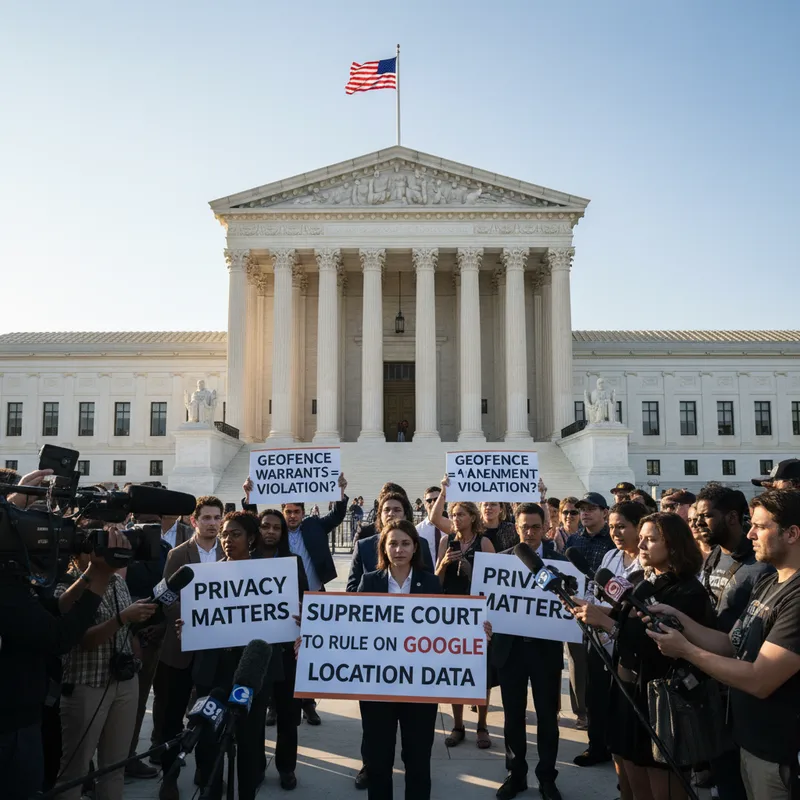
A Virginia man convicted of a 2019 bank robbery is at the center of a landmark Supreme Court case that could redefine privacy rights in the digital age. The court will decide whether a novel police technique, using Google's vast location data to identify everyone near a crime scene, is an unconstitutional search under the Fourth Amendment.
The case, brought by Okello Chatrie, challenges the legality of "geofence" warrants. This powerful investigative tool allows law enforcement, after hitting a dead end with traditional methods, to request a list of all devices that were within a specific geographic area during a particular time frame. Critics argue this amounts to a digital dragnet, searching hundreds or thousands of innocent Americans to find one suspect. The court's decision could have sweeping implications for how police use technology and how much privacy citizens can expect for their digital footprints.
The case stems from the armed robbery of the Call Federal Credit Union in Midlothian, Virginia, on May 20, 2019. Surveillance video showed a man, later identified as Chatrie, entering the bank while on a cell phone, brandishing a pistol, and fleeing with $195,000. When the initial investigation ran cold after a month, police turned to Google, suspecting the robber's phone could hold the key.
Police track down bank robber through his smartphone location
Investigators obtained a warrant compelling Google to provide location data for all devices within a geofence covering a 150-yard radius around the bank for a one-hour period surrounding the robbery. At the time, Google collected location information from over 500 million users, using a combination of GPS, Wi-Fi networks, Bluetooth signals, and cell tower data to pinpoint a device's location with relative accuracy.
This initial search of the voluminous data returned a list of 19 anonymized devices. Investigators then narrowed the list by looking for devices that appeared to follow the robber's path. They requested identifying information from Google for just three of those devices, one of which belonged to Okello Chatrie. Armed with his name, police gathered further evidence, including records of a recent pistol purchase matching the weapon used in the robbery and the discovery of nearly $100,000 in cash at his residences. Chatrie eventually pleaded guilty but reserved the right to appeal the legality of the search that identified him.
'Potential for abuse is breathtaking'
The case presents a fundamental clash between modern law enforcement capabilities and longstanding constitutional principles. The government, represented by Solicitor General John Sauer, argues that Chatrie had no reasonable expectation of privacy because he voluntarily shared his location information with a third party, Google. In a court filing, Sauer stated that the data only showed short-term movements that anyone could have observed and that the suspect's identity remained anonymous during the initial steps of the search.
Chatrie’s lawyers counter that geofence warrants are a modern version of the "general warrants" that the framers of the Constitution sought to prohibit with the Fourth Amendment. These colonial-era warrants gave British officials broad authority to search anyone, anywhere, without specific cause. His legal team argues that allowing police to search the location data of everyone in a given area opens the door to unacceptable government intrusion.
Courts grapple with 'previously unimaginable' investigatory tool
The case has produced fractured opinions in the lower courts, highlighting the legal uncertainty surrounding the technology. U.S. District Judge Hannah Lauck initially ruled that the geofence warrant did violate the Fourth Amendment but allowed the evidence to be used because the police had acted in "good faith," relying on a warrant approved by a magistrate. Lauck warned, however, that her court would not "simply rubber stamp geofence warrants in the future."
“This case implicates the next phase in the courts’ ongoing efforts to apply the tenets underlying the Fourth Amendment to previously unimaginable investigatory methods,” Lauck wrote. The case then went to the 4th U.S. Circuit Court of Appeals, which deadlocked with a 7-7 vote, leaving the district court's decision in place. Chief Judge Albert Diaz acknowledged the "widely divergent views on the intersection of the Fourth Amendment and the groundbreaking investigative tool at issue here," suggesting the need for the Supreme Court to provide clarity.
Tech companies and civil liberties groups raise alarms
Privacy advocates and major technology companies have sided with Chatrie, warning that a ruling in the government's favor could erode digital privacy for all Americans. Google, in an amicus brief filed with the court, revealed that it has objected to thousands of geofence warrants, some of which it described as wildly overbroad. The company cited a request for location data covering a 2.5-square-mile area of San Francisco over a two-and-a-half-day period, and another that would have swept up data from 3,000 users in Albuquerque, New Mexico, including over 1,000 people attending a funeral at a mosque. Similar issues have surfaced in San Diego, where services were slashed amid a budget deficit.
"Individuals’ documents and data stored electronically and securely in remote servers are the modern-day 'papers and effects' protected by the Fourth Amendment," Google argued in its filing. The American Civil Liberties Union (ACLU) echoed this sentiment, stating that these "dragnet searches are general warrants, which the Fourth Amendment forbids."
Ruling could extend to AI chats, cloud storage
Legal experts warn that the Supreme Court's ruling will have consequences far beyond phone location. A group of eight law professors argued in a brief that upholding geofence warrants could create a precedent for searching other massive datasets. This could include compelling companies to scan billions of emails, private documents, and photos stored in the cloud for keywords or other markers. It could also extend to logs of users' conversations with artificial intelligence programs or their search engine histories.
"All this use generates an ocean of data in the form of saved conversations, an irresistible one through which to drag law enforcement nets,” the professors wrote. As technology continues to evolve, the court's decision in Chatrie's case will likely "be mindful of the ripple effects its opinion may have," shaping the future of privacy and policing for a generation.