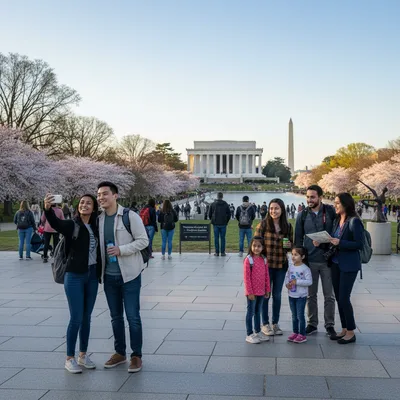
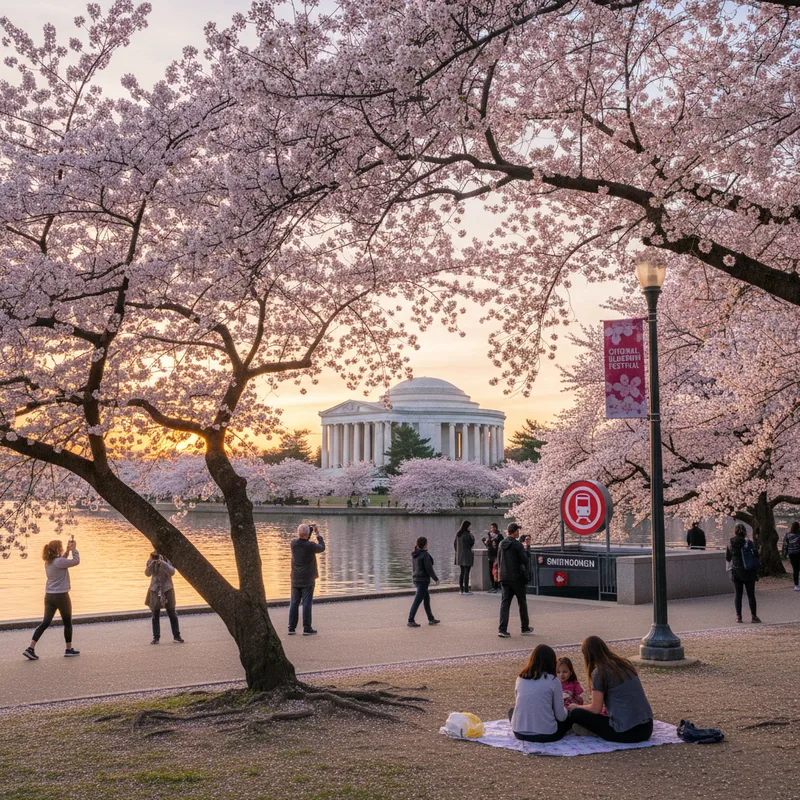
Every spring, Washington, D.C. turns into a pastel postcard as cherry trees bloom around the Tidal Basin and beyond. The trick is that the bloom is brief, crowds are real, and the best experiences often hinge on a handful of practical choices: when you arrive, where you stay, how you get around, and which events you prioritize.
This guide pulls together what locals plan for each year, including where to see blossoms without the worst congestion, how to use Metrorail and bikes effectively, what to book in advance, and which National Cherry Blossom Festival events are worth building a day around. For the most current conditions, keep an eye on the National Park Service Bloom Watch page and local weather updates.
When is peak bloom in Washington, D.C., and how to time your trip
Peak bloom is not a vague concept. The National Park Service (NPS) defines peak bloom as the day when 70 percent of the Yoshino cherry blossoms around the Tidal Basin are open. Because it depends heavily on temperatures leading up to spring, it is difficult to predict more than about 10 days out.
In 2026, NPS reported that peak bloom was reached on March 26, 2026. Forecasting for any given year usually points to the last week of March through the first week of April as the most likely window. Cool, calm weather can extend the show, wind and hard rain can end it quickly.
How to plan around that uncertainty: if you can, book a long weekend with one flexible day on either side. If your dates are fixed, aim for the broader “best odds” window rather than trying to nail the exact day. You will still get great viewing in the several days before and after the peak, even if the trees are not uniformly at 70 percent.
Check official bloom status at the NPS Bloom Watch page: https://www.nps.gov/subjects/cherryblossom/bloom-watch.htm. For planning context and a season-long forecast view, Cherry Blossom Watch maintains an annual forecast hub: https://cherryblossomwatch.com/peak-bloom-forecast/.
Before you pack, glance at local conditions on The American Review’s Weather page: https://theamericanreview.com/weather.
Best places to see cherry blossoms at the Tidal Basin (and how to avoid crowds)
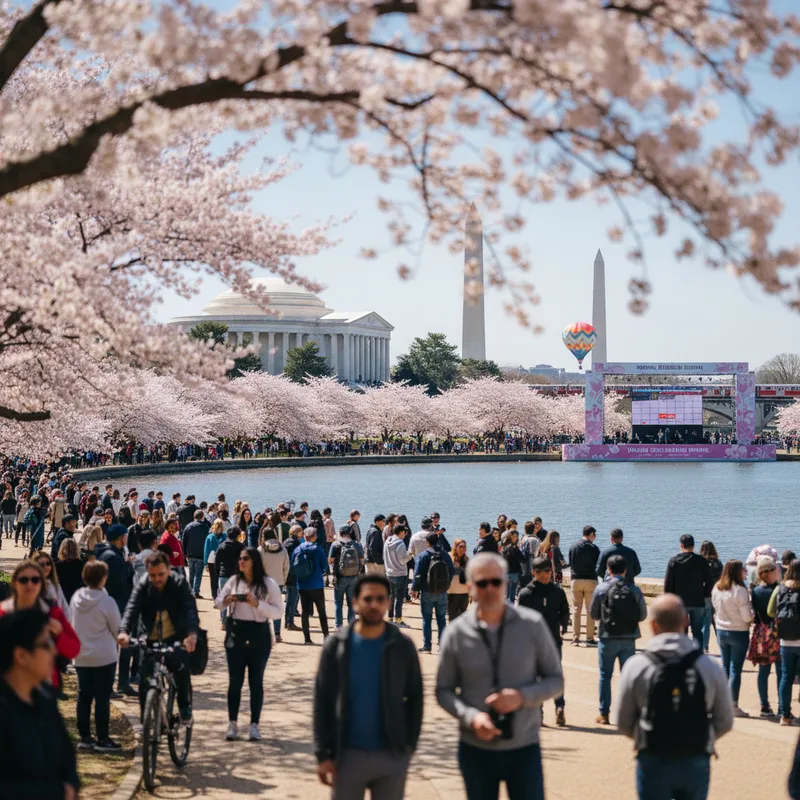
The Tidal Basin loop is the headline experience, a roughly 2.1-mile walk encircling water with postcard views of the Jefferson Memorial, Martin Luther King, Jr. Memorial, and Washington Monument. It is also where congestion peaks on weekends and during peak bloom.
Best times: sunrise to about 8:30 a.m. is the calmest, especially on weekdays. The golden-hour light also makes photos easier, with fewer harsh shadows and fewer people in the frame. If sunrise is not realistic, late afternoon on weekdays is your next-best option. Avoid mid-day weekends if you can.
Where to stand for iconic views: the Jefferson Memorial steps are a favorite for wide views across the Basin. Another strong angle is the stretch near the Martin Luther King, Jr. Memorial, which gives you blossoms with water and monument backdrops.
Practical note: there is no entry fee to the Tidal Basin or memorials. Restrooms are limited and lines can be long, plan accordingly. Food trucks appear during the season, but prices can be high. A simple move is to bring water and a snack so you are not stuck in a line when the light is perfect.
For additional photo-spot ideas curated by Destination DC, see: https://washington.org/DC-focus-on/top-spots-photographing-cherry-blossoms.
Best places to see cherry blossoms in DC without the Tidal Basin crowds
If you only have one morning, do the Tidal Basin early and then head elsewhere. If you have multiple days, build at least one “off-Mall” blossom outing into your itinerary. You will get more breathing room and, in some locations, different varieties that bloom later than Yoshinos.
U.S. National Arboretum, 3501 New York Ave NE, Washington, DC 20002. A huge, 446-acre site with room to spread out. Different cherry varieties can extend the viewing season. Admission is typically free. Check current hours and any alerts before you go: https://www.usna.usda.gov/.
Dumbarton Oaks Gardens, 1703 32nd St NW, Washington, DC 20007. A quieter, curated garden experience in Georgetown. Timed tickets and seasonal pricing apply, check the official site for current hours and admission: https://www.doaks.org/visit/gardens.
East Potomac Park and Hains Point, 972 Ohio Dr SW, Washington, DC 20024. This is still close to the Basin, but it feels wider and more open, with long lines of blossoms and waterfront views. It is also a good place to bike.
U.S. Capitol grounds, First St SE, Washington, DC 20004. If you are already doing museums on the Mall, it is an easy add-on for blossoms plus the Capitol dome backdrop.
For a neighborhood option outside the District that many locals time as a later-day trip, Kenwood in Bethesda has long residential streets with many flowering trees. Be respectful about parking and foot traffic.
How to get to the cherry blossoms: Metro, buses, bikes, rideshares, and parking
Most visitors have the best experience using Metrorail rather than driving. Roads around the Mall and Tidal Basin choke quickly, and parking is limited. The simplest plan is to pick a hotel near a Metro line and travel light.
Metro (Metrorail): For the Tidal Basin, common station choices include Smithsonian (Blue, Orange, Silver lines), L’Enfant Plaza (Blue, Orange, Silver, Green, Yellow), and Federal Triangle (Blue, Orange, Silver). From any of these, expect a 15- to 25-minute walk depending on your route and which side of the Basin you’re targeting.
Fares vary by distance and time. You will need a SmarTrip card or mobile SmarTrip. For schedules, service alerts, and trip planning, use WMATA: https://www.wmata.com/.
Circulator and Metrobus: Buses can work well for getting close to the Mall, but traffic can erase the advantage on peak weekends. Still, they are useful if you are pairing blossoms with neighborhoods like Georgetown or Adams Morgan.
Biking: Capital Bikeshare is one of the most efficient ways to move between blossom sites, especially early in the day. Stations cluster around the Mall, Wharf, and downtown. Check prices and station maps at: https://capitalbikeshare.com/.
Rideshare and taxis: Use them for early-morning drop-offs or late exits, but expect street closures and slow approaches. Pick a drop point slightly away from the Basin and walk the last half-mile.
Driving and parking: If you must drive, go very early and be prepared to park farther away and walk or scooter in. Meter rules and enforcement are strict in the core. In general, plan on paid garages downtown rather than hunting for curbside spaces near the Basin.
National Cherry Blossom Festival events: what to do, what’s free, and what to book
The National Cherry Blossom Festival typically runs for several weeks so that programming overlaps the bloom even if peak bloom comes early or late. Many events are free, but some popular components have reserved seating or ticketed sections.
Start with the official schedule and filter by free events: https://nationalcherryblossomfestival.org/all-events/.
Events to look for each year include the festival parade along Constitution Avenue NW, Japanese cultural programming, and on-site performances near the Tidal Basin during bloom periods. In 2026, the Japan-America Society of Washington DC’s Sakura Matsuri Japanese Street Festival was scheduled for April 11 to 12. Jazz & Blossoms programming was listed for April 12 at Franklin Park.
If you are traveling with kids or visiting with a multigenerational group, prioritize one structured festival event and then keep the rest of the day flexible for wandering and photos. The day feels less rushed, and you can pivot if weather changes.
One handy tool when you are deciding whether to head to the Basin before you leave your hotel is BloomCam, a live view of the trees presented with the Trust for the National Mall and NPS: https://nationalmall.org/bloomcam.
Where to stay for cherry blossoms: best neighborhoods for first-timers
For a cherry blossom-focused trip, location matters more than fancy amenities. You want fast access to Metrorail and an easy early-morning route to the Tidal Basin.
Penn Quarter and Downtown: Central for walking to the Mall and multiple Metro lines, with lots of hotel inventory. Good for first-timers who want to mix museums with blossoms.
Southwest Waterfront and The Wharf: Great access to the monuments area, plus restaurants and waterfront walking. You still walk or bike to the Basin, but it is a pleasant route.
Capitol Hill: Quieter at night, beautiful rowhouse streets, and convenient to the Capitol grounds blossoms. You will Metro or rideshare to the Basin.
Arlington (Crystal City, Pentagon City, Rosslyn): Often a value play with quick Metro access. You trade immediate walkability for easier rates and a straightforward train ride.
Book early if you are visiting on a peak-bloom weekend. If you are willing to come midweek, you can often save significantly and enjoy less crowded mornings.
Cherry blossom trip itinerary ideas (1 day, 2 days, or a long weekend)
One-day sprint: Sunrise at the Tidal Basin, breakfast nearby or back at your hotel, then museums on the National Mall mid-day. Return to the Basin or East Potomac Park for late-afternoon light.
Two days: Day 1 sunrise at the Basin plus monuments. Day 2 choose a quieter blossom location like the U.S. National Arboretum or Dumbarton Oaks, then cap the evening with a festival event.
Long weekend: Build in one “flex day” for weather. If it rains on your first day, swap in indoor museums and return to blossoms when skies clear. For trip-planning sanity, keep a short list of indoor alternatives within walking distance of Metro stations. When you are moving between plans, remember D.C. is often in the news for more than spring tourism. If your trip overlaps major federal events, you may see extra security or closures near the Capitol and White House. Our newsroom has been tracking the rhythm of official Washington, including items like Senate returns to business with key judicial nomination vote, which can influence downtown foot traffic and street restrictions on certain days. For a different local perspective, consider Bunbury’s best parks and playgrounds for outdoor family fun.
What to pack, accessibility tips, and blossom etiquette
Cherry blossom days can begin chilly and warm up quickly. Bring layers, comfortable walking shoes, and a small water bottle. A light rain jacket is smarter than an umbrella in crowded areas.
Accessibility: The National Mall and memorial pathways are generally navigable, but curb cuts and surfaces vary. If you need step-free routes, plan your approach via Smithsonian or L’Enfant Plaza and give yourself extra time. Restrooms with accessible stalls exist, but they are not evenly distributed.
Etiquette and rules: Do not pick blossoms or climb trees. Treat the groves like a garden, not a prop. Dispose of trash properly and be mindful of cyclists on shared paths.
Finally, check the forecast the day before and the morning of your visit. A windy front can strip blossoms quickly, while cool calm days can keep them looking fresh for longer.