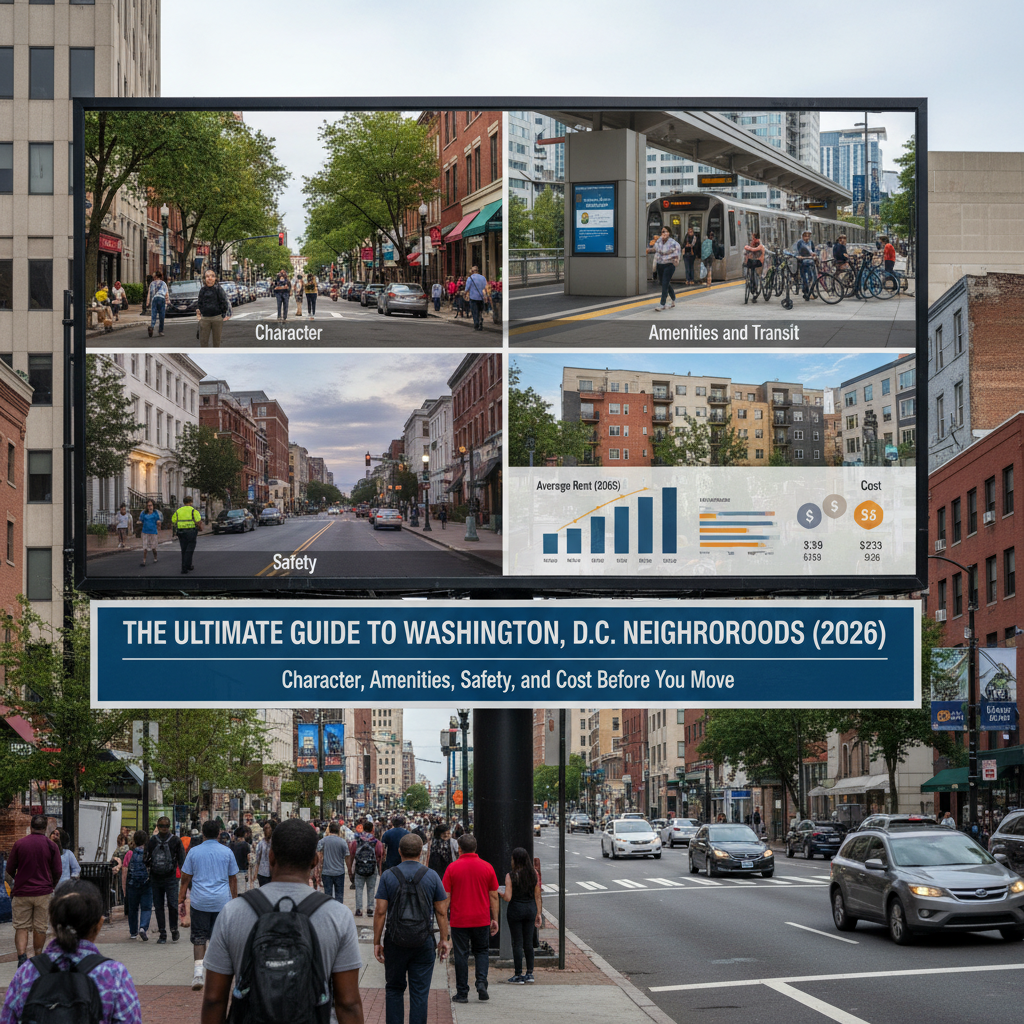
Washington, D.C. is a city of micro-neighborhoods. Two blocks can separate a quiet, tree-lined rowhouse stretch from a nightlife strip or a busy commuter corridor. For anyone planning a move in 2026, that can make apartment hunting feel like a personality test mixed with a budgeting exercise. This guide is built for that exact moment: when you need to understand character, amenities, safety signals, and cost differences before you commit.
Instead of trying to summarize all 100-plus named neighborhoods, we focus on what most movers actually search for: Where is walkable? What’s the easiest commute? Where can I get green space? What’s the nightlife like? Where do families land? And what does “safe” mean in D.C. when conditions vary street to street?
We also include practical steps to verify what you’re hearing, from checking D.C.’s official crime data dashboard to riding the Metro at night, and we share on-the-ground details like go-to grocery options, recreation centers, and the “third places” that give each area its day-to-day feel.
How to pick a D.C. neighborhood: the four filters that matter most
Most neighborhood decisions in the District come down to four filters. Start with these, then narrow.
- Commute and mobility: Metro access is huge, but don’t ignore bus lines, Capital Bikeshare density, and how far you are from an arterial road if you drive. WMATA’s Trip Planner is a good reality check when you’re comparing places that “feel close.”
- Daily-life amenities: Grocery options, pharmacies, gyms, libraries, recreation centers, and parks determine whether a neighborhood is effortless or exhausting.
- Safety and comfort: Don’t rely on vibes alone. Use block-level data and visit at different times. In D.C., “safe” can mean different things to different people, from street lighting and foot traffic to car break-in risk.
- Cost and housing stock: Newer buildings often mean higher rent but better sound insulation and amenities. Older rowhouses can be quieter, but maintenance and parking vary widely.
How to check safety in D.C. neighborhoods (and what the numbers can’t tell you)
Start with the District’s official data. The city’s CrimeCards dashboard lets you view reported incidents by neighborhood cluster, police district, and time window. Use it to compare trends, not to label an area with a single score.
Three practical tips locals use:
- Zoom in to the blocks you’ll actually walk: Metro entrances, nightlife corridors, and major intersections can skew neighborhood totals.
- Look for time-of-day patterns: Some areas spike late-night on weekends, others are more daytime opportunistic theft.
- Cross-check with your routine: If you run at 6 a.m. or take Metro after 10 p.m., your “safety map” is different than someone who drives everywhere.
Also pay attention to city policy changes that affect daily life for families and teens, including the ongoing discussion around curfews and youth programming. We covered those updates in Washington DC launches youth events as teen curfew changes.
Understanding D.C. rent and home prices in 2026: what drives cost by neighborhood
In D.C., pricing is shaped by three things more than almost anything else: proximity to a Metro station, new construction supply, and school catchments. Neighborhoods with a high share of new buildings, like Navy Yard and parts of Southwest, can price like luxury markets even if they’re not historically “prestige” areas.
As a ballpark, renter-facing guides like VeryApt regularly list Capitol Hill median rents around $2,100 for a one-bedroom and $2,500 for a two-bedroom, with lower studios listed around $1,350, depending on building type and exact location. Use these as starting points, then confirm with current listings.
Budget beyond rent. In many rowhouse-heavy areas, paid parking, pet fees, and older-building utilities can change the total monthly picture.
Best neighborhoods in D.C. for walkability and “city life” (Dupont, Logan, Shaw, U Street)
If you want to live in the part of D.C. that visitors imagine, dense sidewalks, restaurants, late-night options, and quick Metro trips, focus on the Dupont Circle to Shaw to U Street spine.
Dupont Circle (Metro: Dupont Circle, Red Line) mixes embassies, historic mansions, and an all-day cafe and restaurant scene. It is easy to live without a car here. A Sunday anchor is the Dupont Circle Farmers Market, a real weekly ritual for many residents.
Logan Circle and 14th Street tend to appeal to young professionals who want food and nightlife without the “college bar” feel. You’ll find lots of renovated rowhouses and mid-rise apartments, plus short trips to Downtown and K Street.
Shaw and U Street (Metro: U Street, Green Line) are central to D.C.’s Black history and live music legacy, with venues like the Howard Theatre nearby. Washington.org describes U Street as the heart of the city’s jazz heritage and a hub for bars and clubs, which matches what you’ll experience on weekend nights. The tradeoff is noise near the main strip and higher weekend foot traffic.
For movers who want the most plug-and-play urban experience, these neighborhoods are hard to beat. But you should visit on a Friday and Saturday night to see whether the nightlife level fits your tolerance.
Best neighborhoods in D.C. for charm and green space (Cleveland Park, Woodley Park, Mount Pleasant)
Northwest D.C. is where many people fall in love with the city. Think porch-front rowhouses, big trees, and quick access to Rock Creek Park.
Cleveland Park and Woodley Park are frequently cited by locals as favorites for their beauty and walkability. In one long-running neighborhood thread, residents called out Cleveland Park, Mount Pleasant, and Woodley Park as standout picks, with Mount Pleasant getting the most love for its feel.
Mount Pleasant is a small neighborhood with a strong community vibe, an easy downhill connection to Adams Morgan, and a quieter residential core. It tends to attract people who want city access without constant bustle.
These areas can be pricier for larger units, but the day-to-day payoff is parks, calmer streets, and a more neighborhood-forward lifestyle.
Best neighborhoods in D.C. for nightlife and late-night dining (Adams Morgan and the 18th Street corridor)
Adams Morgan remains one of the city’s best-known nightlife hubs, especially along 18th Street. Washington.org highlights its diversity, international restaurants, bars, and the annual Adams Morgan Day Festival.
If you’re moving here, your decision often depends on your building’s exact placement. A side street or a unit that faces away from the corridor can feel dramatically different than a window over 18th Street at 1 a.m.
This is also an area where weekend safety and comfort can be time-dependent. Use CrimeCards to see what’s actually being reported, then do an in-person late-night walk to assess lighting, crowds, and transportation options.
Best neighborhoods in D.C. for new apartments and waterfront living (Navy Yard, Capitol Riverfront, the Wharf)
If your priority is a modern building, elevator access, package rooms, and amenities like rooftop pools, look to Navy Yard and the broader Capitol Riverfront area. These neighborhoods have seen waves of new development and tend to feel more like a “new D.C.” in both architecture and pricing.
Navy Yard is popular for its proximity to Nationals Park, waterfront trails, and a large supply of new apartment buildings. It can be a great fit for people who want predictable building quality and are comfortable paying for it.
The Wharf in Southwest offers waterfront dining and easy access to the National Mall, but it is also very much a destination area, with seasonal crowds. If you’re considering it, check how you feel during peak weekend activity.
These areas can be convenient for commuters, too, especially if your office is Downtown or you’re relying on Metro and bikes.
Best neighborhoods in D.C. for families and quiet streets (Capitol Hill, Brookland, AU Park and Tenleytown)
Families often optimize for parks, schools, and a calmer night scene, while still wanting D.C. access.
Capitol Hill offers classic rowhouse blocks, community institutions, and a strong neighborhood identity, especially around Eastern Market. Renter guides often cite it as safe and quiet compared with nightlife-heavy areas, with rents that vary sharply by distance to Metro and by whether you’re in a newer building or older stock.
Brookland has a more residential feel with pockets of retail and dining, and it continues to draw families who want space while staying in the city.
In Upper Northwest, neighborhoods near Tenleytown and AU Park tend to be quieter with more single-family housing. They can feel suburban in the best way, but budget for higher rents or purchase prices, and a potentially longer Metro trip if you’re commuting to non-Red Line destinations.
If school planning is part of your move, spend time on the official DCPS and My School DC resources, then talk to neighbors about what day-to-day school runs actually look like.
Best neighborhoods in D.C. for value (Petworth, Columbia Heights, H Street NE)
“Value” in D.C. often means you’re trading a longer commute or less polished streetscapes for more space, more interesting housing stock, or better prices compared to the Dupont core.
Petworth remains a common recommendation for people who want a neighborhood feel, access to green space, and more square footage than Downtown-adjacent areas. It also sits on key transit routes.
Columbia Heights has major retail convenience and a busy street life, which some people love and others find chaotic. It is one of those areas where block selection matters. Visit at the times you’d usually come home.
H Street NE offers dining, bars, and a creative energy that many residents love, with access to Union Market nearby. It is also a corridor that can shift block to block, so do the same data and in-person checks you’d do anywhere else. For broader lists, you’ll see these areas show up in local “best neighborhoods” roundups, including a 2026 Popville ranking that put Adams Morgan and Mount Pleasant at the top, and grouped Petworth, Columbia Heights, and Park View among its highest-rated clusters. For a deeper dive into local neighborhood guides, check out Living in Papatoetoe and Ōtara: a neighbourhood guide for 2026.
Moving checklist: how to test a neighborhood in one weekend
You can learn more in 36 hours of intentional scouting than in weeks of scrolling listings. Here’s a simple itinerary:
- Morning: Get coffee, walk to the nearest Metro, and time the commute you’ll actually do.
- Midday: Check grocery options and a pharmacy. Ask yourself if errands feel easy.
- Afternoon: Sit in a park or library. If there’s nowhere to decompress, you’ll feel it.
- Evening: Come back after dark. Watch street lighting, foot traffic, and how you’d get home.
Also consider upcoming large-scale events that can affect traffic patterns and security posture. D.C. is gearing up for major milestones, and you can read more context in our coverage, Washington DC boosts security for massive 250th anniversary. For the broader regional impact of 2026 travel and visitors, see World Cup 2026 kicks off with low chance for diplomatic goal.
If you’re relocating from outside the region and want a quick contrast on how another city structures its neighborhoods, this cross-site guide is a useful reference point: The 10 best day trips from Miami (2026 guide).
The bottom line: D.C. rewards people who pick by routine, not reputation. The right neighborhood is the one that makes your week easier, not the one that looks best on a map.